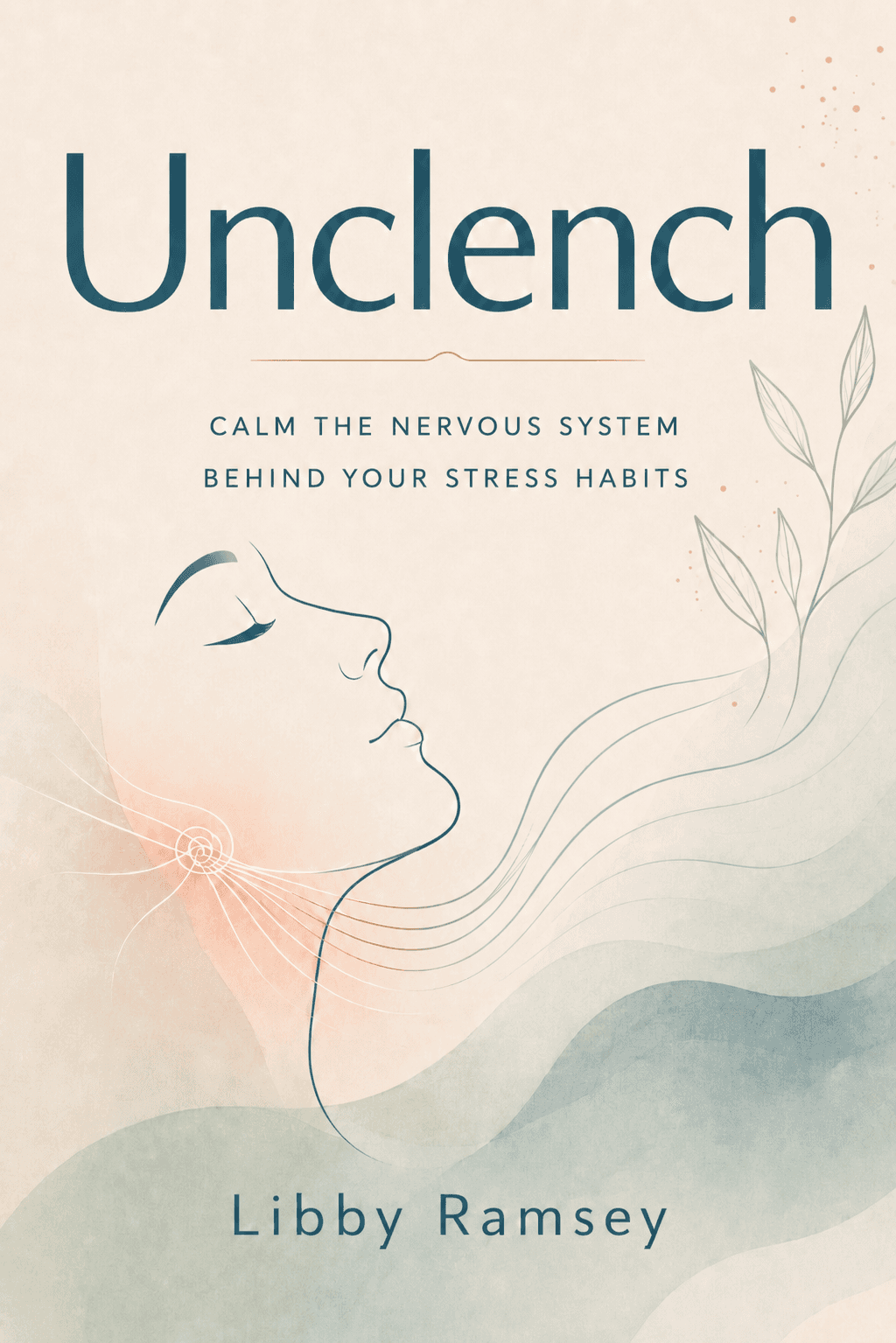
Unclench
Calm the Nervous System Behind Nail Biting, Teeth Grinding, and Being Wound Up
By Libby Ramsey
If your body seems to clench, grind, bite, or brace on its own, and no amount of telling yourself to relax has changed it, this short guide was written for you. It treats the habit as a signal from a nervous system stuck on, and shows you how to settle it.
Digital ebook (PDF) + 21-day app · Coming soon · Free 21-day reset available now
If your body won't switch off, two things are worth saying
1
It isn't a character flaw.
These are common ways a stressed nervous system discharges tension.
2
The calm is learnable.
Settling the system is a skill, and this is a gentle way to practice it.
The reframe
You were fighting the wrong battle
For years I treated my jaw clenching, nail biting, and that wired-but-tired restlessness as separate bad habits to white-knuckle away. Willpower worked for an afternoon, then the tension found another way out.
What finally helped was seeing them as connected: a nervous system stuck in low-grade fight-or-flight, leaking stress through the body. When I learned to settle that system, the urges got quieter on their own. That shift, and the daily practice built around it, is what Unclench is about.
Sound familiar?
I tried to muscle through it
Each one managed a symptom. None of them reached the system underneath.
What's inside
A short book, built to be used
Inside the guide
Digital ebook (PDF) + 21-day app
- 01
It's not willpower, it's wiring
Why grinding, biting, picking, and fidgeting so often share one root, and why just stop has always failed you.
- 02
Meet your nervous system
Fight-or-flight in plain English, hyperarousal, and the vagus nerve as the body's off switch.
- 03
Find your pattern
A short self-assessment: which habits, when, where, and what sets them off.
- 04
The toolkit
The physiological sigh, box breathing, humming, cold-water reset, jaw release, and how each one works.
- 05
The 21-day reset
A gentle daily practice that builds from a few minutes to an automatic baseline. The core of the app.
- 06
The 60-second Urge SOS
Five quick interrupts for the moment an urge actually hits.
- 07
Making it stick
Folding the practice into your day, handling slip-ups, and keeping the baseline down.
- 08
When to get help
Honest pointers on when grinding, picking, pulling, or hyperarousal is worth a professional's time.
The full day-by-day protocol lives inside the book and app. The site teaches the science and the individual tools; the sequence that ties them together is the paid depth.
What it is
- A short, practical read you can start in one sitting
- A calming nervous-system practice you can actually keep up
- Grounded in published research, written in plain language
- One frame for many habits: it's wiring, not willpower
What it isn't
- A cure or a permanent fix
- Therapy, or a replacement for it
- A medical or dental treatment
- A trauma-healing program
- A guaranteed result on a fixed timeline
- A substitute for seeing a professional when you need one
Is it for you?
Who this book is for
A good fit if you
- Clench, grind, bite, pick, or fidget under stress and want a calmer approach
- Have tried to just stop and found willpower runs out
- Prefer plain language and a practice you can keep up
Probably not if you
- Are looking for a diagnosis or medical treatment
- Want a guaranteed or instant fix
- Have picking or pulling that feels compulsive (a mental-health professional can help first)
The book
Unclench
Calm the Nervous System Behind Nail Biting, Teeth Grinding, and Being Wound Up
- Digital ebook (PDF) + 21-day app
- Coming soon
- Start in one sitting
Want a note when it launches? Email support@nervousbody.com.
Unclench is general educational information based on lived experience and published research. It is not medical, dental, or psychological advice, does not diagnose or treat any condition, and makes no guarantee of results. Persistent teeth grinding can damage teeth, so see a dentist; skin picking, hair pulling, and nail biting can become compulsive, and a mental-health professional can help. If you feel constantly on edge, please talk to a doctor.